Against the CGT Discount
May 2026
Seeing a lot of talk lately about Australian startups and the removal of the CGT discount.
I know this won’t be popular in my network, but: The CGT discount was a very bad policy and I’m glad it’s being scrapped. This doesn’t mean we shouldn’t have concessions to promote new business formation (more below) - but if you think the best way to spur Australian innovation is a blanket 50% discount on all nominal capital gains, you’re wrong.
I’m sure I’ll make some mistakes in this article - I’m not an economist. But given the appalling lack of economic and moral clarity I keep seeing in the typical discourse surrounding this federal budget, I’m gonna be a “risk taker!” and post anyway.
All views are my own, completely unrelated to any current or previous employers.
1: Who pays CGT?
Before talking about startups, it’s a good idea to ground the discussion in some basic context. I did some coarse-grained analysis with Claude on the question “For every $1 of CGT Australia raises, where does it come from?” The (approximate!) breakdown is
- Investment properties: ~46%
- Listed equities (ASX+International): ~34%
- “Bullshit” (crypto+collectables): ~5%
- Mature large private companies (PE-backed, e.g. Canva secondary in 2023): ~5%
- Operating small/medium business / family company shares: ~4%
- Company operating-asset & business sales: ~3%
- Scale up companies (100-500 employees) ~2%
- “True startups” (<100 employees, < Series B) less than 1%
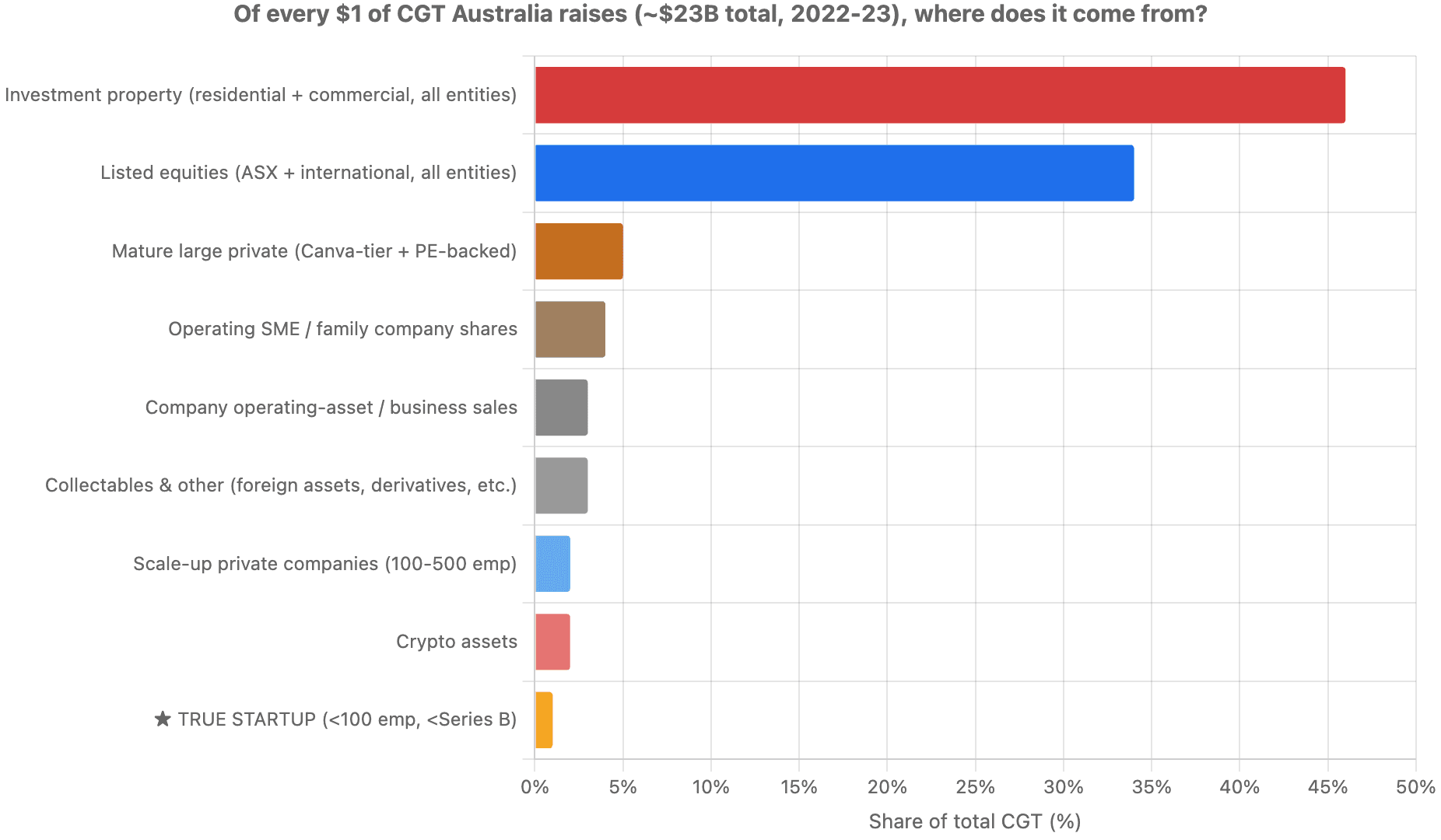
This breakdown doesn't mean there's no downside to applying CGT to startups. I acknowledge that taxing mature large companies still affects the incentives faced by startup founders and investors (will talk much more about this below).
Still, it’s good to flag off the bat: the bulk of CGT falls on assets people hold passively where the tax doesn't strongly distort behaviour.
Another basic point that’s worth calling out early - only Australian tax residents pay CGT, so concerns about international capital flight, and associated research on tax policy related to this, are not especially relevant to this discussion.
2: Worthy Contributors
A powerful sentiment often animating those who oppose the CGT discount is something like:
“Entrepreneurship is the life-blood of our economy. Without people who create businesses we’d have no production, and no prosperity”
I’ve got zero objections to that statement, it’s completely valid. If you’re a business owner in Australia who provides a valuable good/service to people - sincerely - thank you for what you’re doing for Australia.
But please recognise - the following statement is also true:
“Workers are the life-blood of our economy. Without employees, we’d have no production, and no prosperity”.
The fact is - nearly all productive activity generates positive spillover for others. Rent-seekers and vice-peddlers aside, most people who get paid to do something make money because someone else valued what they did. And when they get paid, the compensation received almost always understates the full social benefit provided. This is true of entrepreneurs, small business owners, and workers alike.
We’re super lucky to live in a civilization where this kind of voluntary exchange positive-sum dynamic pervades. The best kind of society is one where the most effective way to enrich yourself is by disproportionately benefiting others.
When the owner of a local cafe brightens their customers’ day with much needed flat white in the morning - they’re making a commendable contribution to Australia. When the farm manager overseeing a huge corporate-owned avocado plantation spends hours on the phone coordinating with suppliers, they’re making a commendable contribution to Australia.
When a group of talented young professionals make an attempt at setting up a new AI-native accounting firm - they’re making a commendable contribution, and when the cleaners come in to their office after dark to scrub the toilets, they’re making a contribution as well.
Let's give all these people a label: Worthy Contributors. Anyone doing honest, productive work in Australia - owner or employee - is a Worthy Contributor, generating real value for others.
Even though they’re all doing something worthwhile, this doesn’t mean every Worthy Contributor provides an equal level of value. A junior draftsperson earns a fraction of what a senior structural engineer earns, who in turn earns a fraction of what a C-suite executive at Lendlease earns. And that makes sense, given the varying degree of contribution each of them make to getting buildings up.
It makes total sense that different people earn different amounts of money, and no serious person objects to this. To maximise our shared prosperity, it’s important to ensure those who generate more value receive more financial reward.
Exactly how much real value any one person provides is impossible to measure directly - but to a first approximation, a pragmatic proxy for it is the amount of money other people were willing to pay for it. This applies irrespective of whether you made your money via employment or entrepreneurship.
In order to fund the government, states need to raise tax revenue. Australia, like basically every country, generates most of its government revenue by taxing the earnings of its citizens. Due to welfare and fairness considerations, the rate of taxation is lower for people with low earnings versus high earnings.
Because the amount of money someone gets paid is a proxy for social value created - it’s generally a good idea for two people with the same earnings to face the same tax rate. This is because it’s fair, and also, because taxing all forms of income equally, to first approximation, incentivises individuals to seek out the occupation where they can have the highest earnings, and thus make the greatest social contribution.
I’ll write more below about how someone’s earnings isn’t a perfect measure of value created, but as a starting point, this is the baseline: a country full of Worthy Contributors (employees, contractors, SMB operators, corporate execs, etc) all generating value for others, all facing the same tax schedule, and all getting compensated roughly in proportion to the benefit they provide to the country.
3 - Randian Protagonists
Now, after sketching out this very high level general picture, I’m sure many readers object that there are specific considerations that apply to business owners which break the symmetry here.
It’s conceivable that for some group of people (tech startup founders, perhaps...) the significance of their economic activity goes beyond that of a Worthy Contributor. A subset of our society whose positive spillover, per dollar earned is so much greater than what Worthy Contributors produce that we ought to carve out a separate tax regime specially for them.
Let’s give a label to this elite cadre of group of people, we’ll call them Transcendent Economic Heroes
It’s plausible that some people really do deserve this label - and when the label really does apply, it certainly could be in our national interest to apply a unique tax treatment to their earnings.
But it’s worth being clear about how extraordinary someone must be to earn this label.
If a full-time daycare worker earns ~$600,000 over a decade, while a startup founder spent that same decade building a business which they exit for $600 million, the founder's bid to be enshrined in the cohort of Transcendent Economic Heroes isn't merely a claim to have produced ~1,000x more social value than the daycare worker. That 1000x is already reflected in their earnings. To be a Transcendent Economic Hero, the founder needs to justify why the social value they provided is much more than one thousand times that of the daycare worker.
And hey, maybe sometimes this is really true. I’m not saying Transcendent Economic Heroes aren’t ever real. But there are some reasons to doubt that in general the founders of VC-backed startups really meet this extreme standard.
4 - Big companies provide value too
It’s sometimes tacitly assumed that all growth and innovation comes from startups, or that “tech” and “startups” are the same thing. They aren’t.
In the first five months of 2025, Alphabet added more to its market cap than the combined value of every startup that ever went through Y-Combinator across its entire 30 year history.
That statistic is a problem for the claim that startup founders are Transcendent Economic Heroes.
During cofounder Larry Page's time as CEO, Alphabet’s market cap grew from zero to about $440 billion. Under Sundar Pichai's subsequent leadership, it grew by another ~10x, now sitting around $4.4 trillion. So Pichai presided over a market cap increase roughly ten times greater than Page's.
Yet Pichai's net worth is now around 200x smaller than Page's. Naively, that's a 2,000x disparity in compensation-per-dollar-of-value-created. This is in the wrong direction for the “founders-are-undercompensated” story.
Some of this gap is real risk premium: Page took early-stage risk that Pichai didn't. But the risk premium doesn’t explain the 2,000x gap in CEO net worth per dollar of market cap created. The only satisfying resolution: neither Page nor Pichai is single-handedly responsible for Google's success. By Pichai's era, Google was a much larger company with vastly more employees, and the credit for the 1000% growth in market cap after Pichai took the reins has to be distributed across tens of thousands of people working there. The math only checks out once you admit that employees inside large firms are also capable of creating very large amounts of value.
While Australia doesn't have any companies at Google’s scale, we do have large organisations, and there are lots of talented hard working Worthy Contributors inside those organizations.
It’s a popular narrative that Australia would be more prosperous if we had more startup founders.
But looking at the Alphabet numbers - it’s not obvious that on the margin, pushing talented workers out of high-skilled roles in established Australian companies so they can start their own is necessarily going to be a good thing. Firms exist for a reason, and for many, in fact for most people - they are more productive inside a large company than they would be as an entrepreneur or a worker in a small business.
The US stock market should definitely be glad for the highly skilled employees who remained at Alphabet and let its market cap skyrocket. Plausibly, having the tax system put too much of an opinionated thumb on the scale when it comes to an individual’s decision about whether to be a founder or an employee doesn’t really make our country richer overall.
5 - Value Creation, and Value Capture
Lets return to the point above about the amount you get paid being a proxy for the social value you create. It’s obviously not a perfect metric.
In fact, Peter Thiel’s main piece of advice he offers for startup founders is: you don’t get paid based only on the value you create. You get paid based on the value you create multiplied by the proportion of that value you’re able to capture for yourself.
I love working in the tech industry, and overall I think software is a great thing for the world - which is why it pains me to admit this... But over the past decade it’s become increasingly obvious that part of the software industry’s outsized success is due to it being unusually good at the “value capturing” part, not just the “value creation” part.
Per Bendigo Bank's 2025 Farmland Values report, a hectare of Australian cropland goes for around A$8,000, and a hectare of grazing land for around A$500. Doing a rough back-of-the-envelope calculation - if we multiply this out by the total amount of agricultural land in the country (~30Mha of cropland plus ~360Mha of grazing land), we find the total value of all the farmland in Australia is about A$420 billion. This is substantially below META’s current market cap of ~A$2.4 trillion.
If the country could give up all our farmland in return for turning Meta into an Australian company, would we take the trade? Fuck no. It’s abundantly clear that value created by the food Australia grows and exports vastly outweighs the social benefit of being able to do really really good targeting on instagram ads. Meta is obviously a company which manages to capture an outsized amount of value for its own shareholders relative to the good it actually does in the world.
This isn’t a unique quirk of Meta either, it’s a recurring pattern across high-growth tech.
Coinbase has a market cap around 50 billion USD. More than the total revenue from Moderna’s COVID vaccine. Coinbase obviously will not bring more good into the world than the Moderna vaccine.
Australian startup Afterpay sold in to Block 2021 for about A$44 billion. Qantas and Virgin (together making up over 90% of our domestic aviation industry), have a combined market cap of about A$15 billion. Does the ability to make fashion purchases in 4 easy installments really generate 3x the social value for people as giving us the ability to fly?
These are extreme examples, but they illustrate a pervasive trend. I’m not trying to say tech is bad, most of the time when a tech company is successful, a great deal of that success derives from the fact they built a product that people really benefit from.
But even for these “good” companies, when they see YoY revenue growth, it’s valid to consider some of this growth as being thanks to “value creation” - improvements made to the product which actually made their customers better off, and another component as being thanks to “value extraction” - activities which optimize the business in a way that doesn’t directly benefit customers like running A/B testing on a pricing page or nudging people to drop out of your cancellation flow.
Tech companies generally seem to have more of an edge than others when it comes to capturing the value they create. I don’t fault them; of course a business wants to maximise profits. And it’s generally true that even if a company succeeds in capturing a large chunk of the surplus generated, in aggregate the world is still better off thanks to that company’s existence.
But remember, advocating for startup founders to carry the mantle of “Transcendent Economic Hero” requires justifying why, compared to other Worthy Contributors, founders are systematically undercompensated relative to the value they create.
Tech being relatively good at value capture is an argument in the opposite direction to this.
Taking this even further, I’d wager that if we looked across different founders working on different things, those whose motivations are most sensitive to the marginal tax rate on a successful exit will be disproportionately the ones building businesses that are better at value capture.
6: A legitimate argument for startup concessions
While I am very skeptical of “Transcendent Economic Hero” stories, I’m happy to acknowledge that there are some separate, actually good arguments in favor of special tax concessions for capital holders. These good arguments boil down to the concept of risk aversion:
Everyone is at least somewhat risk-averse. A 50% chance of $0 and a 50% chance of $2M is not equivalent to a guaranteed $1M. Almost anyone would take the guarantee over the gamble.
While everyone in the economy takes some degree of risk - a founder of an early-stage company with unicorn potential faces a risk profile that is unusually extreme. A high probability of years of below-market wages and personal stress culminating in nothing, weighted against a small probability of staggering success.
This potentially creates a genuine wedge between national and personal interest - where in expected value terms a particular founder taking the leap would be in Australia's interest, but variance is severe enough to make the prospect not in the founder’s personal interest.
If that dynamic repeats across hundreds of would-be-founders who never take the risk, this can leave our country poorer.
This is a legitimate problem that is genuinely worth addressing - but once we note that the distortion that needs correcting relates to risk aversion, it becomes clear the CGT discount is basically the most stupid, expensive, inefficient means of correcting for it that you could possibly dream up.
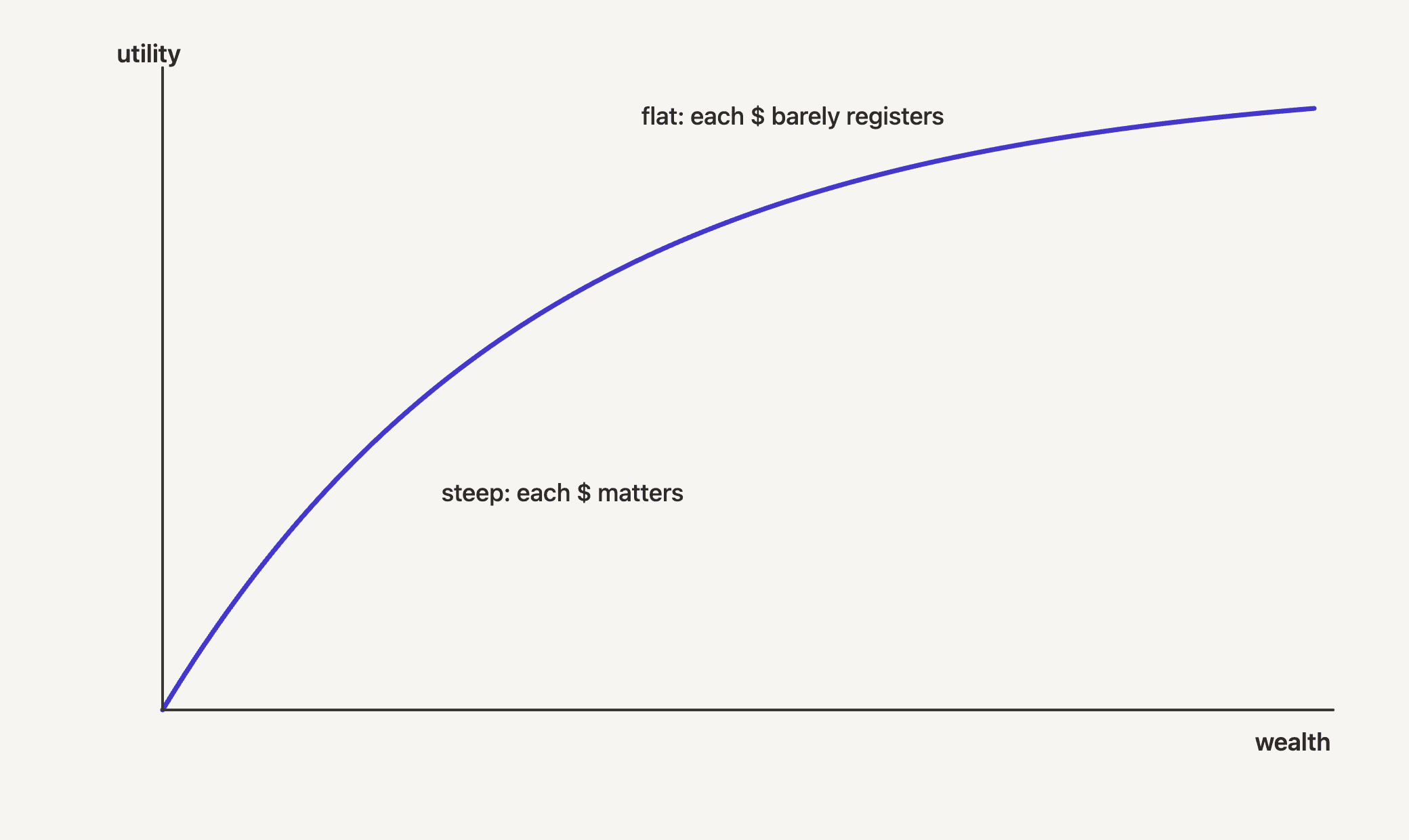
Risk aversion is a rational response to the fact that money has diminishing returns. Your first $100k a year transforms your life. Your second matters less. By the ten-thousandth, the extra barely registers.
Plot a chart of utility versus wealth and you get a curve that's steep at the bottom and flattens as you move right.
Now let’s imagine a simplified example of a founder’s decision to start a company. Suppose if they try and do a startup, and it fails, they’ll miss out on an extra 200k of after-tax wages. But in the unlikely case (~1%) where they succeed they’ll end up eventually exiting the company with a 200M post tax capital gain.
This is a case where the expected return is massive, so from the perspective of Australia’s national interest we really want them to go for it. But if this potential founder is risk averse, perhaps they choose to stay at their job anyway.
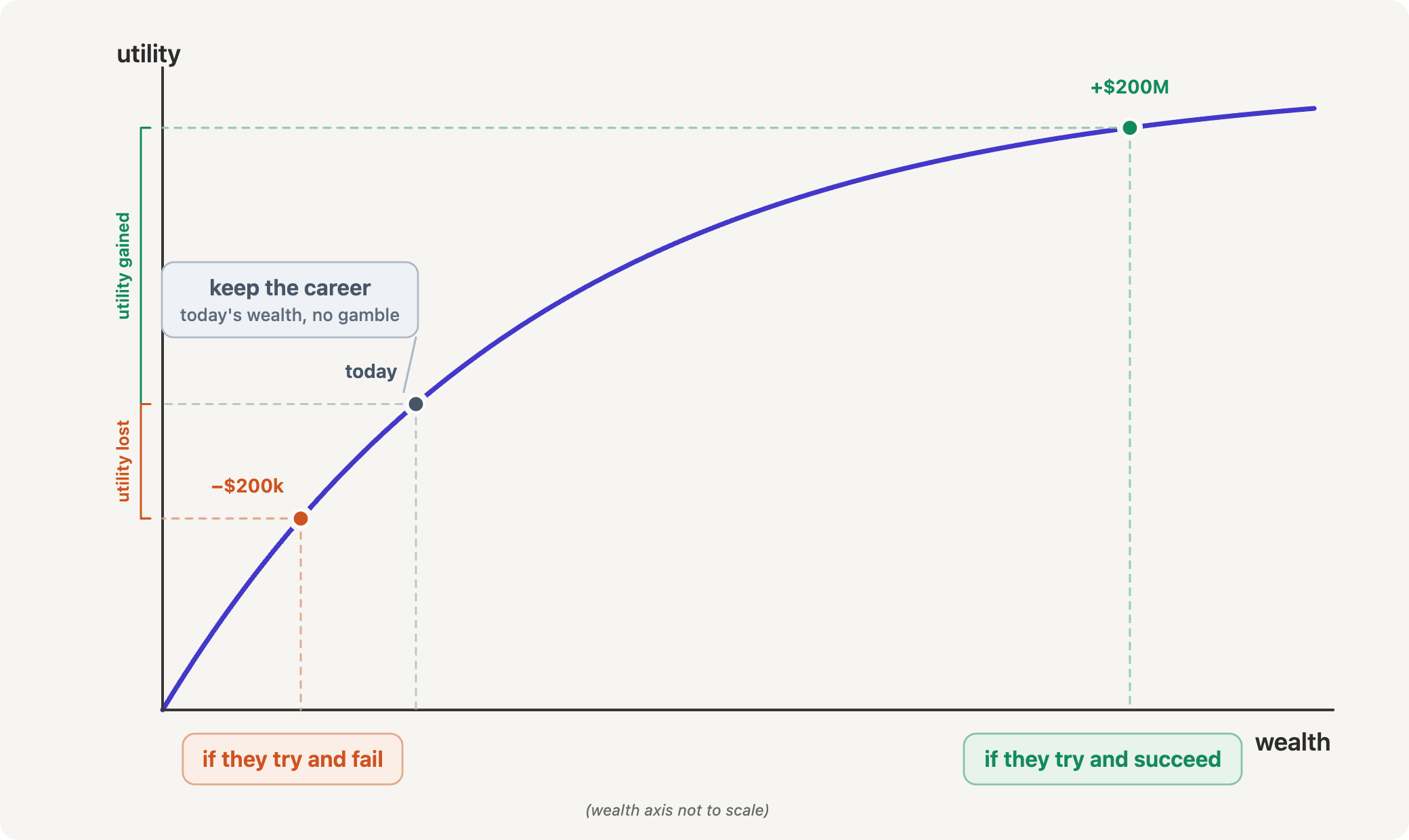
(This is oversimplified for illustrative purposes, obviously in the real world there's many possible outcomes besides total failure and massive success, and the founder is motivated by many things besides just $, e.g. building new skills, but most of that nuance further weakens case for CGT discount anyway, so can be safely ignored for sake of argument).
If we wanted to adjust the tax regime to better entice this founder to take the plunge, one lever we could pull is to give them a massive tax concession in the case where they secure a massive exit, allowing them to keep 300M after tax instead of just 200M.
This expensive, regressive subsidy is unlikely to tip the scales for this founder. The very fact the founder is risk averse means their utility curve is flatter at high levels of wealth, which means the impact of a subsidy in the world where they are already very wealthy is severely muted.
On the other hand, consider an alternative policy like
“Founders who fail and later return to employment can average their income over the years they spent not earning high salaries to reduce their future tax bill in later years after they return to a high income”
This is a non-regressive policy which massages founder incentives in the very steep region of their utility curve - and thus does a much better job of encouraging risk taking per dollar spent.
This isn’t the only way we could tweak the tax system to encourage new businesses and useful investment either.
Investors already get concessions to invest in Early Stage Innovation Companies (ESICs). Maybe we could also give ESIC founders/early employees an incentive where the cost base of their company stock resets when the business first crosses a 100M market cap.
But whatever tax concessions you do support - they need to recognise the basic economic fact that, when seeking to encourage rational risk-taking, it’s more efficient to soften the loss than it is to sweeten the gain.
Any tax proposal truly grounded in Australia’s national interest should absolutely not allow a founder or investor to exit with an outlandish sum of personal wealth while avoiding the top marginal rate on their billionth dollar.
As well as being regressive, and being a maximally inefficient mechanism for promoting risk taking - CGT discount was also just a badly designed instrument in general. By applying a flat discount to nominal gains, this meant after adjusting for inflation, investors with higher rates of real returns paid lower real marginal tax rates. It also brings a bunch of nonsense along for the ride, treating anything held for more than 12 months including crypto, derivative positions, passive asset-flipping and pokemon card collecting as being the same thing as building/growing a company.
If we had 2 billion dollars carved out of the federal budget every year and it was your job to figure out how to deploy this in order to boost startups and innovation in Australia, is the very best idea you can possibly come up with “let’s give payouts to successful investors in proportion to their nominal gains”? I really hope it’s not...
So even if you believe in the need for tax concessions to smooth out the risk profile of high-growth startups - using a blanket CGT discount as a kludgy “regressive insurance scheme for founders” is close to the worst possible design imaginable. If we didn’t currently have a blanket CGT discount - nobody would dream of seriously presenting it as the optimal policy lever to pull to encourage new startups.
Advocating for cheap, effective proposals that actually make sense is worthwhile - and the government might actually listen.
But demanding we preserve the 50% CGT discount exactly as it was is not a serious proposal and when you do it, you’re not helping to improve the quality of governance in Australia.
7: Political equilibria
Governance in Australia is, by international standards, remarkably good. Sadly, the fact that our nation is still capable of major, ambitious, sober reforms makes us an unusual standout compared to other democracies.
You don’t have to spend long looking at politics in US, UK, France, Germany, Italy, the Netherlands, or Sweden to realise how good we’ve got it here right now.
For the aspiring billionaire founders lamenting how these CGT changes make them want to move their company to the USA - while it’s true the startup ecosystem is doing great right now, that country also suffers from:
- A huge, accelerating peace-time deficit
- A hideous form of corruption and populism practiced by the current ruling party
- Top figures in their opposition party openly considering far more punitive measures against the wealthy than what Australia is doing (Think Warren’s wealth tax, or Mamdani filming ticktocks outside people’s houses)
Before jumping ship to the US, please consider what the relationship between the rich and the poor is like over there. If you decide to leave to America with your fortune, there’s gonna be a much higher proportion of the public who hate you for the wealth you have. Hating you to such an appalling extent that they would literally celebrate your death (think Brian Thompson, the Titan submarine, etc.)
What the current government is doing is not punitive. It’s an attempt to preserve social cohesion, control the deficit, close loopholes, and make taxation more neutral with regards to how people make their money.
The proposed changes are not perfect. You can definitely criticise things like carried losses not being indexed to inflation (or argue we should only tax gains above the risk-free rate). But nits aside, overall this suite of reforms is a sensible attempt to hold our social fabric together while stopping well short of the truly destructive class warfare that really destroys a nation.
If you are not the natural constituency for the kind of technocratic centrism being practiced by the current administration - then who is?
When people like us spit the dummy at being taxed according to rules similar to those which workers have experienced for decades, and set out to inflict political damage on the government that tried to pursue this reform, the ultimate outcome will not be an Australia that keeps happily humming along the way it always has been as we continue enjoying the same concessions as before.
If a concerted push actually does succeed in toppling this government and reinstating a massive tax discrepancies between workers and owners - the outcome will be rising resentment, future MPs becoming increasingly populist, and ultimately some future legislation which really does place punitive punishments on the wealthy and destroy our economy
8: A Spiritual Illness
There are a lot of reasons someone might aspire to be a successful startup founder.
Some founders are partially driven by caring deeply about their company's mission. Some are motivated by a need to be in control of their own journey rather than taking directions from someone else. Others are excited by the prospect of, in the words of Steve Jobs, “making a ding in the universe”.
Some founders love the energy they feel when they're surrounded by a team of incredible people all striving hard towards a shared goal.
Some entrepreneurs crave the connections and influence that come along with being ultra successful. Some want to enjoy the feeling you get by being at the top of a status hierarchy.
Some people want to push themselves to find out just how much they're truly capable of. Some are competitors at heart who simply love the game. Some are driven to keep going by a sense of obligation to their cofounders and employees. And, yes, some component of the motivation is also the prospect of one day walking away with a fuckload of money.
Given the intricate tapestry of drives and desires that play into someone's decision about what to devote their life to, it honestly seems pretty unlikely that someone who would have been driven enough to make it would have been deterred by the prospect of someday paying the top marginal tax rate. If you know anything about the origin stories of OpenAI and Anthropic (the most important startups of this decade by far) - it's pretty obvious that the tax treatment of a hypothetical future exit would not have influenced their founding teams in the slightest.
When it comes to the most valuable tech company Australia's ever produced - I don't pretend to know anything about the founders' personal views - but it's interesting to note that all three founders have (to their extraordinary credit) pledged to donate the majority of their wealth to philanthropic causes.
For any founders, or aspiring founders reading this - I have huge admiration for your ambition, and I really hope you succeed. I never want you to feel like you can't be a tall poppy - you can be a giant fucking Californian redwood if that's what you wanna be. On your journey to build an enormously profitable business, I'll be cheering for you. If someday you get to sell your stake in your company for 500 million dollars - and you're not inclined toward philanthropy - I'll be genuinely pleased on your behalf as you enjoy this extravagant personal wealth.
You did something great, and now you get to enjoy 5,000 times more wealth than your uber driver. Congratulations, you've earned it.
But if after finding this cosmic success, you still feel wronged by the rest of society for not getting to be 7,500 times richer than your uber driver instead - there's something ugly about this.
When your company succeeds, and grows its headcount to 100 employees, then 1000, then beyond - how do you want those people to feel about what they do? How eager will you be to broadcast the notion that entrepreneurs fundamentally contribute more, and deserve to keep a greater share of the spoils of their labour, than workers do? Will you secretly hold your workers in contempt, believing they'd be doing more for the world if they all left to start their own companies? Or do you believe in your company enough to think it's exactly where a smart, ambitious person should go if they want to have the biggest impact they can?
Will you, as a billionaire, be able to maintain your friendships with your non-billionaire friends, while at the same time protesting about how unfair it is you had to pay the same marginal tax rate as they did?
Don't make it lonelier at the top than it has to be. You can still be great without needing to be fundamentally greater than the rest of us.